What People Are Saying
Voice Training App
-

"Amazing!! I've been doing exercises daily and in just 3 days my vocal range has increased almost 2 notes. This app is really amazing. Thank you guys. This is probably the best app that has happened to me. All I know this is working. Truly truly amazing!!!"
A User from Spain -
"Hi, came here to leave an honest and happy review. I wasn't even asked, just decided to of my own free will! My vocal chords have been getting smoother and better, more relaxed and I can hit more notes better and more easily. Very happy with these results."
Jasmine
🎤 Voice Training - Learn To Sing App
Learn To Sing by Doing — and Hear When You're In Tune
With Voice Training - Learn To Sing you build your voice the way singers always have — by listening, matching pitch and repeating until it sticks. The app listens to you through the microphone and tells you, note by note, whether you are singing in tune. Daily warm-ups, range tests and song-style riffs guide you from your first confident note to a wider, smoother, stronger voice. With over 10 million users and a 4.2-star average from more than 28,000 reviews, it is one of the most popular and trusted ways to learn to sing in tune.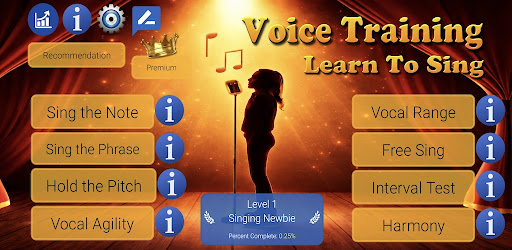
Choose any singing exercise — warm-ups, range builders, agility runs, song riffs, harmony, interval test.
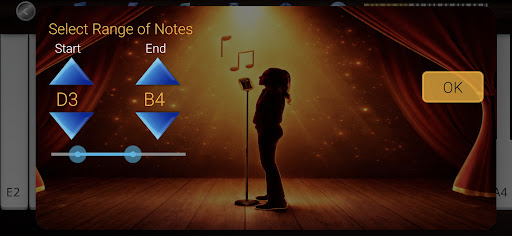
Find your lowest and highest notes with the vocal range test, then watch your range grow over time.
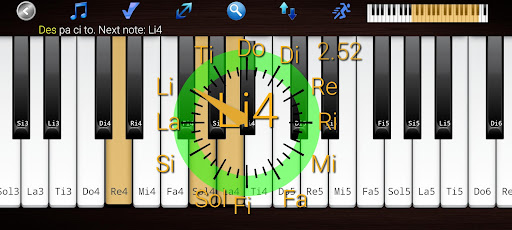
Sing into the mic and the app shows whether you are sharp, flat or right on the note — in real time. Competent singers can see how accurate to perfect pitch they are.
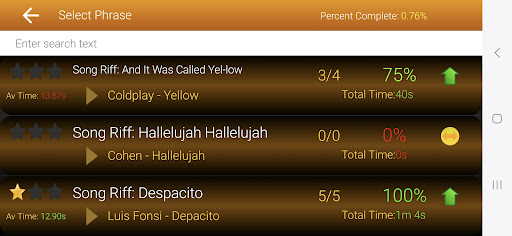
Practise song-style riffs and runs to build agility and control across your whole range.
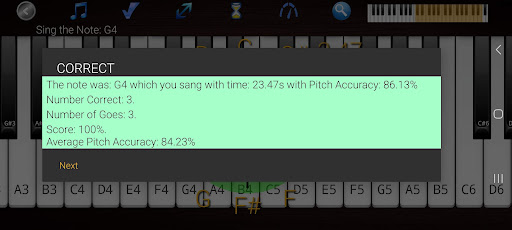
The app listens to you sing and gives feedback on pitch accuracy. Track your progress over time.
Download Voice Training - Learn To Sing


Blog
 Benefits to Singing
Singing brings many benefits such as reducing stress, enhancing mood, better cardiovascular and lung functioning and social cohesion.
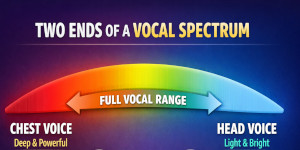 Chest vs Head Voice
What is the difference and how to smooth the gap.
Frequently Asked Questions
How do I understand the pitch gauges?
The dial shows if you are singing too flat (gauge needle to the left and a negative frequency distance) or too sharp (gauge needle to the right and a positive frequency distance). The circle turns green when you are singing in tune, but to be perfect you should aim to get the needle centre-top with a 0.0 frequency distance.
Why is there a piano?
Most professional singing teachers use a piano as a guide to teach singing, and this app aims to simulate that experience. All professional singers can sing to a piano.
How do I know whether I'm getting any better at singing?
Use the Progress button on the Menu page to check your performance. Selecting a specific row in the Progress page takes you to that exercise and level so you can improve your score. Stars are awarded for accuracy, performance and time on the exercise.
What do I sing?
We recommend singing an 'OH' sound first and then training the other vowels. The primary five vowels of singing are OH-AH-AY-EE-OO, and you can use an M sound to start the vowel like a hum: mOH-mAH-mEE-mOO. Each vowel uses different vocal muscles and the aim is to strengthen them all. Remember to relax and never strain.
I want to sing lower than E2 or higher than G6.
In the settings, make sure Best Octave is unchecked so the app detects the octave you are singing. No professional bass singer ever needs to go below E2 and no professional soprano will go higher than C6, so G6 is more than enough.
What are the pitch algorithm choices?
FFT (Fast Fourier Transform) is a fast, reliable all-rounder that works well for most singing and music. Goertzel is efficient and lightweight, best for detecting specific frequencies in noisy environments. YIN is autocorrelation-based — highly accurate for clean vocal signals and subtle pitch differences, especially at lower frequencies.
✨ What Makes It Unique
Co-designed by Professional Singing Teachers
Most singing apps are like karaoke - a fun game. Voice Training - Learn To Sing is different: It has been co-designed by singing teachers to train your voice so you can sing with better pitch accuracy, nail the essential intervals, expand your vocal range and vocal agility and more. It is like having a patient singing teacher with you at every practice, instead of a backing track you sing along to and hope.Built Around Exercises, Not Songs
Warm-ups — gentle daily routines that relax and prepare your voice so you sing better and protect your vocal cords.
Range builder — test your lowest and highest notes, then extend your range safely a little at a time and watch it grow.
Agility & riffs — song-style runs and riffs that train pitch accuracy, control and confidence across your whole voice.
Why Singers Love It
Because it gives instant, honest feedback, the app suits complete beginners who have never sung a note as well as singers who want to push their range and accuracy further. There is no sheet music to read and nothing to set up — just pick an exercise, sing, and see exactly how you are doing. Working through the levels, the app can recommend whch particular exercises to do so every session fits your voice. Come back daily to see and hear real, measurable progress. With over 10 million users and a 4.2-star average from 28,853 reviews, it has helped a huge community of singers find their voice.Singing boosts mental health

1. IMPROVES HAPPINESS. Singing releases endorphins and oxytocin, hormones associated with pleasure and bonding. A 2017 study published in Frontiers in Human Neuroscience investigated the effects of choir versus solo singing on mood and stress-related hormones. The study concluded that whilst both choir and solo singing can positively influence mood, choir singers reported more happiness.
2. REDUCES STRESS. Singing can effectively reduce stress by lowering cortisol levels. The same study also measured participants' salivary cortisol, a hormone associated with stress, before and after singing sessions. The findings revealed a decrease in cortisol levels post-singing, indicating a relaxation response.